

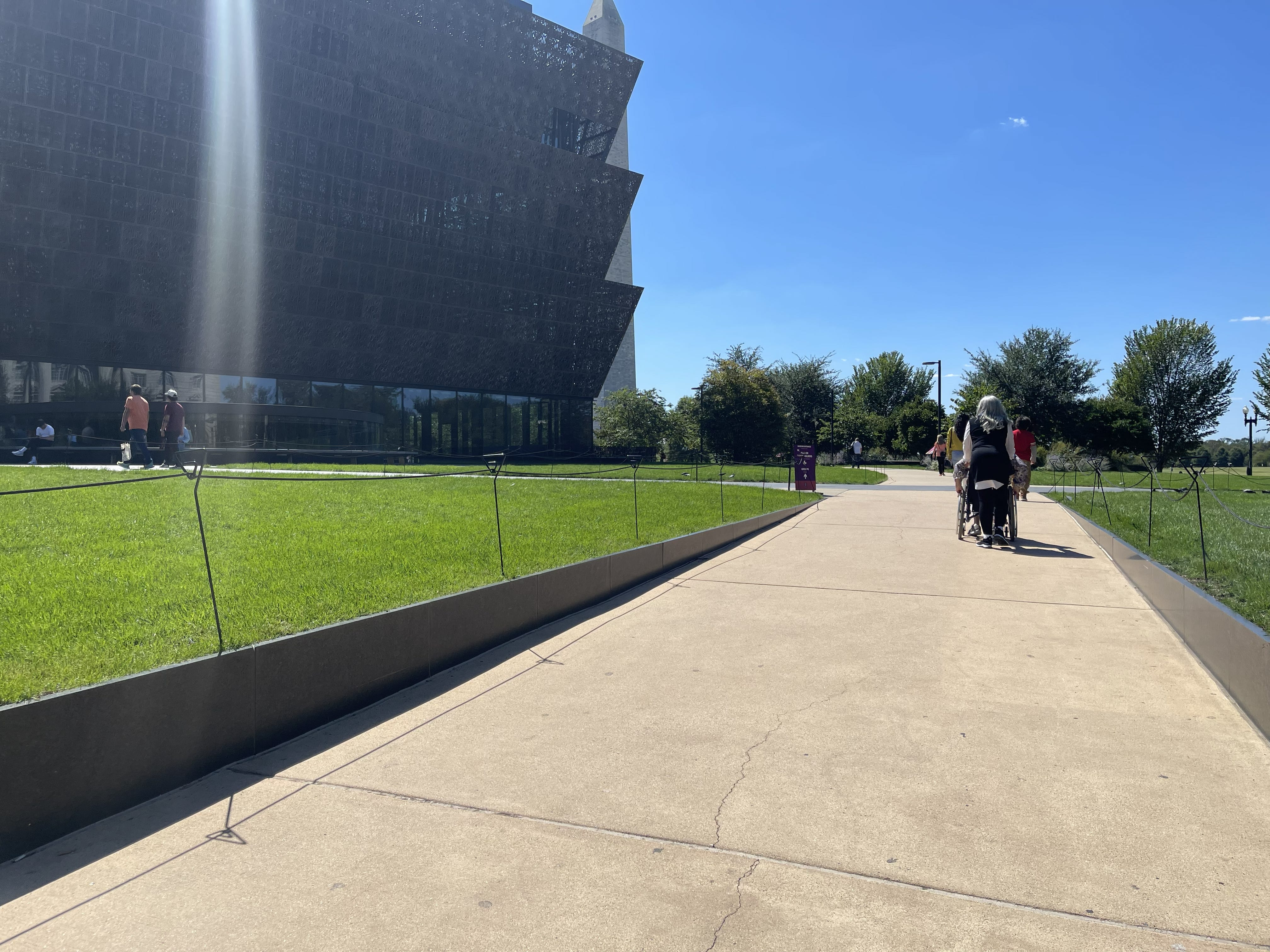
The subterranean galleries of the National Museum of African American History and Culture are designed to pull you down before they lift you up.
To reach the beginnings of the transatlantic slave trade, you descend several stories below ground into low, dim, compressed corridors. Last September, I was in Washington, D.C., for the American Association of People with Disabilities (AAPD) 2nd Annual Disability Power on the Hill event. Between policy sessions and meetings with lawmakers, I entered those galleries with two fellow advocates from Georgia: Lee, rolling beside me in her power scooter, and Diana—just a few years our senior—who had traveled as Lee’s close friend and personal care attendant.
Getting there had already been an exercise in community care. As a middle-aged, ambulatory wheelchair user, I had planned to self-propel the long trek from our hotel down to the National Mall, but Diana would not hear of it. She insisted on getting behind my chair, navigating cracked sidewalks, curb cuts, and crosswalks under the late-summer D.C. sun, pushing me the entire way while keeping pace with Lee’s scooter. By the time we crossed the museum threshold, Diana had already poured out significant physical labor just to ensure we all arrived safely and comfortably.
Inside, the physical access was undeniable. The ramps were wide, the slopes compliant, the elevators spacious. Federal architecture had done the mechanical math.
Almost immediately, the emotional architecture told an entirely different story.
What Wheels Can’t Measure
While Lee and I navigated the galleries on wheels, Diana walked alongside us. A personal care attendant is never simply an observer; they are constantly tracking logistics, energy levels, physical comfort, and spatial safety. It is an act of sustained, interdependent attention—and Diana had already spent miles of her morning literally pushing my wheels forward.
As we moved through the lowest levels—where the timber beams of slave ships, iron shackles, and auction notices line the walls—our experiences began to splinter.
As a white woman from Oregon, I was looking at the exhibits through the lens of civil rights law, policy, and historical education. I was absorbing information, observing structural racism documented behind glass, connecting archival past to legislative present.
For Lee and Diana, two Black women from the South, the air in those galleries carried a distinct, personal gravity.
Diana was not studying history; she was encountering her ancestors’ stolen breath. The compression of the low ceilings and the unfiltered documentation of torture, auction blocks, and generational terror were not abstract lessons. They were an embodied, suffocating weight layered on top of the constant physical and emotional vigilance demanded of Black women in America—women who have historically been expected to absorb, hold, and care for everyone else's needs before their own. She had spent the morning physically carrying others; now the space was asking her to carry centuries of collective grief.
A few galleries in, Diana stopped. The load became too immense to hold inside that subterranean space. She quietly let us know that she had to step away, make her way back to the elevators, and go outside into the open air just to breathe.
That moment dismantled any comfortable assumption that accessibility begins and ends with ADA compliance. You can build all the wide ramps and spacious elevators in the world, but if a space refuses to reckon with the somatic, generational toll carried by the people entering it, true accessibility has not been achieved. The NMAAHC under founding director Lonnie G. Bunch III succeeded precisely because it refused to soften that blow. It did not exist to comfort visitors; it insisted on bearing witness.
The Disabling Machine of Slavery
Looking at those subterranean exhibits alongside Lee and Diana brought to mind the work of historian Kim E. Nielsen. In A Disability History of the United States, Nielsen makes an indispensable intervention that conventional historical narratives routinely ignore: chattel slavery was America’s original, brutal engine of mass disability.
As Nielsen documents, slavery was a fundamentally disabling institution. The daily violence of the plantation—whippings that severed nerves, malnutrition, unyielding physical torment, and deliberate maiming—systematically created physical and cognitive impairments.
Simultaneously, the ideology of disability was weaponized to justify human bondage in the first place. White enslavers argued that Black people lacked the cognitive and emotional capacity for freedom, framing subjugation as a benevolent necessity. When enslaved people fought back or fled, the white medical establishment invented psychiatric diagnoses to pathologize their desire for liberty. Enslaved human beings were judged entirely by their physical capacity to produce labor; when violence or age broke their bodies, they were treated as disposable.
Rolling through those exhibits, Nielsen’s analysis makes the truth inescapable: you cannot separate the story of race in America from the story of how power has maimed, defined, and discarded human bodies. The iron shackles behind the glass were not just instruments of racial subjugation; they were literal disabling devices.
The Theater in the Lobby
When you emerge from those harrowing depths into the soaring, sunlit glass of the central atrium, your eyes inevitably land on the grand, polished entrance of the Oprah Winfrey Theater.
When The Oprah Winfrey Show entered national syndication in 1986, I was just starting college. For the next twenty-five years, until the finale aired in 2011, I was a devoted viewer. Like millions of white women of my generation, my daily understanding of empathy, personal transformation, and aspirational resilience was shaped in no small part from across her television stage. Later, her $21 million gift was instrumental in pulling the museum out of congressional purgatory and onto the National Mall.
Spending time listening to Black women and grassroots organizers over recent years offers an essential education in the limits of high-profile, billionaire philanthropy. Oprah’s storytelling has historically favored narratives of individual resilience, forgiveness, and triumph over structural confrontation—stories carefully calibrated to soothe broad, predominantly white audiences while leaving systemic structures largely undisturbed.
Standing in that lobby, the polished lettering on the theater felt like a monument to a comforting fiction: the idea that immense private wealth and celebrity patronage can construct an untouchable sanctuary for truth.
The illusion did not hold. Just weeks after our visit, a congressional budget standoff shut the federal government down. The museum burned through its modest operational reserves within days, and the doors were locked. For more than a month, the grand theater, the subterranean galleries, the elevators, and the archives sat dark—held hostage by federal purse strings.
The Price of Institutional Erasure
Now, the vulnerability of that model has reached its inevitable crisis point.
Lonnie Bunch—the historian who spent nearly four decades in the Smithsonian system and more than ten years building the African American Museum from an empty office into a national treasure—has announced his retirement as Smithsonian Secretary following relentless pressure from the White House.
The political script is as predictable as it is dangerous. An administration issues executive edicts demanding that cultural institutions purge narratives that portray Western systems as oppressive. High-profile museum leaders are summoned to congressional hearings. Museum directors are forced out for refusing to abandon diversity frameworks. MAGA officials demand that federal collections tell a sanitized, celebratory tale of national glory.
When political intimidation replaces historical rigor, the first casualties are always the unvarnished truths of state-sponsored harm.
If an administration forces our national museums to erase the reality of institutional violence, they are not simply sanitizing racial history—they are erasing the disabling violence that built this country. They erase how eugenics was codified into state law, how disabled bodies were sterilized against their will, how state asylums warehoused generations of human beings, and how Black disabled Americans continue to bear the disproportionate brunt of police violence and medical neglect.
Furthermore, attacks on DEIA initiatives inevitably dismantle institutional accessibility. Across federal agencies, diversity and civil rights mandates are precisely what fund and protect audio description programs, tactile exhibits, sensory spaces, neurodivergent accommodations, and specialized access staff. Rebranding civil rights as “partisan ideology” provides immediate cover to gut the infrastructure that allows disabled people to enter public spaces in the first place.
Nothing About Us Without Us
Lonnie Bunch understood that the legitimacy of a historical institution rests entirely on its refusal to lie. He spoke openly of the immense stress of navigating bad-faith political hostility while trying to protect his curators.
His departure exposes the ultimate peril of relying on federal funding and polite billionaire patronage to protect collective memory. When political power shifts toward authoritarian nostalgia, billionaire donors tend to retreat into philanthropic diplomacy, and federal charters become levers for censorship.
The foundational principle of the disability rights movement is deceptively simple: Nothing About Us Without Us. It demands that the people who lived the struggle must retain absolute authority over how that struggle is told, preserved, and remembered.
Diana did not need to step outside that day because she lacked strength; she stepped outside because she had spent her physical energy lifting us up, only to be met with a history that the walls of the museum finally dared to honor. If we allow state power to pave over those subterranean galleries with sanitized patriotic myths, we are abandoning everyone who carries the weight of that truth in their bones.
Lonnie Bunch’s departure makes the stakes crystal clear: our history cannot be left to cautious boards of regents, political appointees, or high-dollar galas. When our public institutions buckle under the pressure to forget, the labor of remembering falls, as it always has, squarely on the shoulders of the community.
To learn more about the institutional forces that pushed Lonnie Bunch out, I strongly recommend reading The Smithsonian’s Secretary is Resigning by historian and educator Kahlil Greene. You can follow his ongoing work unpacking buried and threatened history at History Can’t Hide.