

On the 69th floor of the North Tower, the emergency door swung open to reveal a narrow vertical tube of dim fluorescent light and raw concrete.
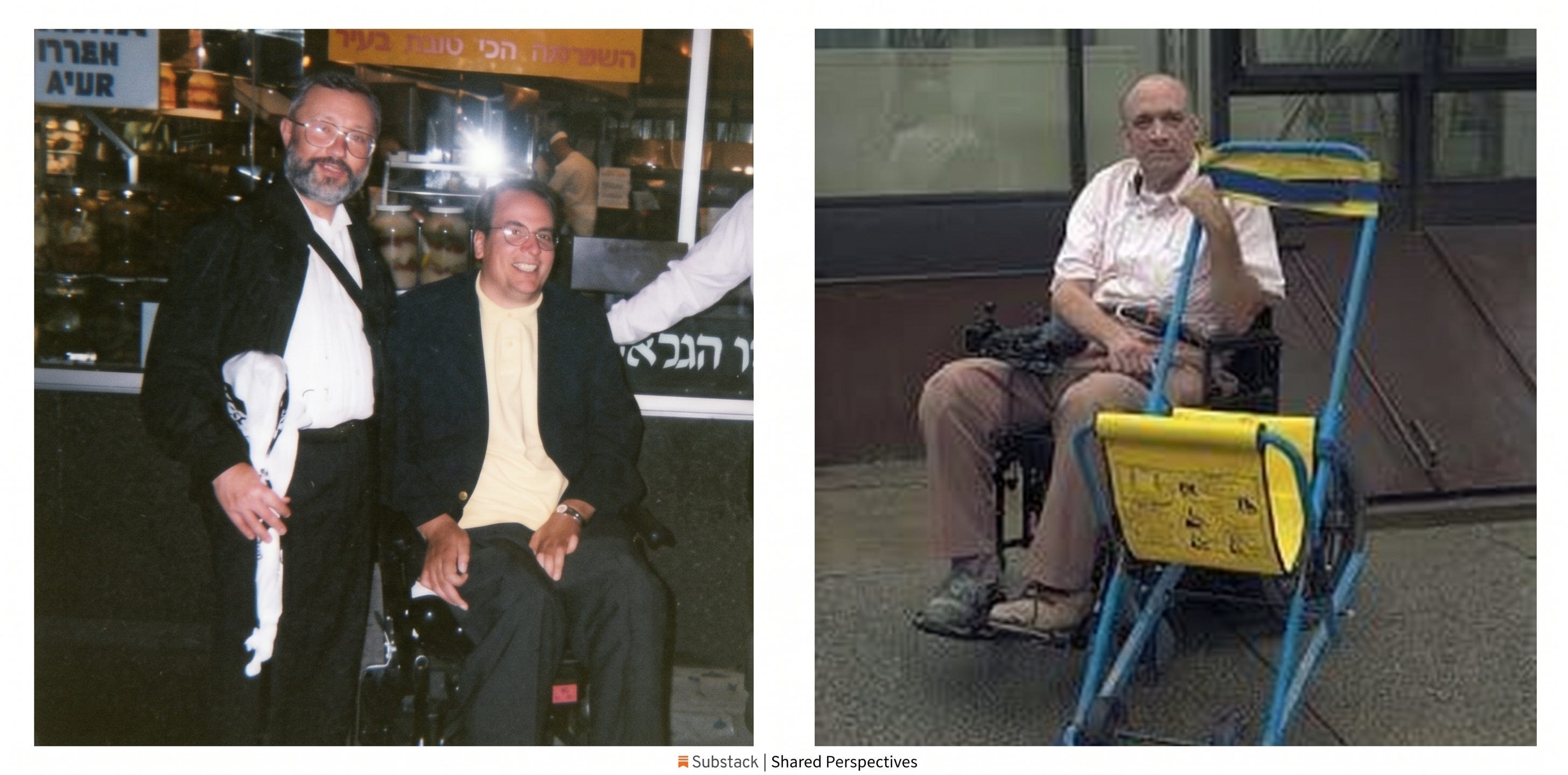
John Abruzzo, an associate accountant with C5–C6 quadriplegia working for the Port Authority of New York and New Jersey, looked down past the toes of his shoes at the first flight of stairs. Thousands of concrete and steel steps separated his desk on the 69th floor from the pavement of Vesey Street, and the wheels of his brand-new power wheelchair were stopped dead by the sheer drop of the first step.
Abruzzo had already survived the 1993 World Trade Center bombing. That afternoon, his evacuation had taken six freezing hours through smoke and darkness as coworkers risked their lives hauling his massive electric chair down twenty-five flights before transferring him onto a canvas stretcher. Determined never to be caught defenseless again, Abruzzo had successfully pushed the Port Authority to purchase specialized tracked emergency chairs—Evac+Chairs—and keep one mounted near his desk.
Now, with Flight 11 having struck forty floors above, Mike Fabiano, a Port Authority colleague serving as a floor fire warden, immediately ran to Abruzzo’s side. Fabiano and a small group of coworkers lifted Abruzzo out of his power chair, strapped him into the narrow canvas sling of the emergency evacuation chair, and tipped the frame back toward the lip of the stairwell.
As the chair’s rubber tracks caught the concrete edges of the steps, a sharp, rhythmic thud-thud-thud shuddered through the aluminum frame and straight into the forearms of the men gripping the rails.
For ninety minutes, as heat built and sweat slicked the handrails, a devoted team of ten coworkers took turns carrying out the descent. Nine of them—Michael Ambrosio, Peter Bitwinski, Philip Caffrey, Richard Capriotti, Michael Curci, Wilson Pacheco, Anthony Pecora, Gerald Simpkins, and Peggy Zoch—rotated in pairs and trios to steer and brake the chair.
A tenth coworker, unable to assist physically with the heavy carry, took on another vital role: scouting ahead down the dark, crowded shaft. When he hit thick smoke around the 40th floor, he guided the entire group across the core to cut over to a clearer stairwell.
Fifty floors down, near the 19th floor, they encountered ascending firefighters who urged them to surrender Abruzzo to the department and save themselves. They refused, gripping the handles and pressing downward together.
When they finally spilled out into the lobby, the South Tower had already collapsed. The floor was drowned in burst-pipe runoff, ceiling wreckage, and a jagged carpet of shattered glass.
Raw-handed and breathing smoke, the group carried the chair over the debris, hoisted Abruzzo straight through a blown-out window frame, and set him onto the sidewalk just ten minutes before the tower fell.
Abruzzo kept the evacuation chair for years as a tangible reminder of his coworkers’ refusal to leave him, before the chair was later placed in the permanent collection of the National September 11 Memorial & Museum. It remains physical proof that when institutions fail to engineer an exit, survival falls entirely to individual foresight, mutual refusal, and ad hoc solidarity.
42 Floors Down
Forty-two floors down, in an adjacent concrete shaft, Ed Beyea had no such equipment.
Beyea, a 42-year-old computer programmer with C3 quadriplegia on the 27th floor, sat parked on the landing in his motorized wheelchair. Beside him stood his closest friend, Abraham Zelmanowitz.
As chronicled in New Mobility in November 2001 and documented by The 9/11 Legacy Foundation, the two had worked side by side for over a decade at Empire Blue Cross and Blue Shield. Their bond grew from daily, quiet interdependence. Often after work, the two would hang out at Beyea’s apartment. Despite living with daily pain, Beyea knew how to enjoy life—smiling, cracking jokes, and savoring a good Cuban cigar. To make those moments easier, Zelmanowitz, an observant Orthodox Jew, rigged up a custom holder so Beyea, a Catholic, could reach down and gently pick up the cigar with his mouth.
Every few months, they treated themselves to special dinners at kosher restaurants alongside friends and Irma, Beyea’s daytime personal care attendant. On those nights, they took turns picking up the tab and never skimped: “They ate only the best,” Irma remembered. “Whatever they wanted, they got.”
Unlike the Port Authority floors above, their private commercial tenant space had no evacuation chair. Moving a heavy power chair down twenty-seven flights of concrete stairs was physically impossible.
When the plane struck, Irma was sixteen floors above them in a restroom near the 43rd-floor cafeteria. She felt the structure lurch like an earthquake, stepping out into a corridor slick with pipe runoff and abandoned lunches as smoke drifted through the dining hall. Taking the north stairs down to the 27th floor, she crossed over to the south side of the tower to find Ed.
Zelmanowitz had just reached Beyea’s side when another man approached, offering to take Beyea down the stairs.
Ed refused. Weighing nearly 300 pounds, he knew from previous transfer injuries that an improvised carry down a tight, jolting stairwell risked fractured bones or severe respiratory compromise. He needed at least three firefighters trained for a heavy carry—not a hurried two-man lift. He also refused to let his body obstruct the narrow lane of egress for colleagues rushing past.
“None of us were thinking then that the building might collapse,” Irma later recalled. Ed insisted others go ahead, while Zelmanowitz volunteered to stay at Beyea’s side and encouraged Irma to leave because the gathering smoke was making her cough.
Beyea urged his friend to escape, too, but Zelmanowitz made an instant choice: he would not leave.
They did what high-rise emergency doctrine instructed disabled occupants to do: step out of the descent flow, wait on the landing, and rely on first responders equipped for an assisted carry. Reaching the lobby amidst a human chain guiding people out into the street, Irma found a firefighter and gave him Beyea’s exact location.
“Please take care of him,” she pleaded. “He needs oxygen.” Though Ed typically used oxygen only to sleep, the suffocating atmosphere inside the core demanded it. The firefighter promised to find him.
Back on the 27th floor, Zelmanowitz spoke to his family by cell phone, assuring them he was safe while gently resisting his elderly mother’s pleas to get out. He stayed side by side with his closest friend on that concrete landing—trusting an official safety procedure that ran out of time before the ceiling fell in.
Three days later, President George W. Bush honored Abraham before the nation:
“One man, who could have saved himself, stayed until the end at the side of his quadriplegic friend.”
The Americans with Disabilities Act was eleven years old that morning. Its successes were visible everywhere: lowered elevator consoles, widened doorways, and curb cuts smoothing the way from the sidewalk into the lobby.
Federal law had opened the front doors of corporate high-rises. It simply had not required a way out when the power cut and the shafts filled with smoke.
The Cruelty of the Blueprints
Critics sometimes dismiss what happened on those landings as the cold math of catastrophe, arguing that disaster inevitably strips away civil society and leaves only survival of the fittest. That claim ignores what really happened inside those stairs.
People did not trample each other down the North Tower stairwells. They yielded space, passed water bottles, held heavy fire doors open, and took turns carrying coworkers. Zelmanowitz stayed; Abruzzo’s colleagues carried him until their arms gave out and others stepped in.
The brutality of that morning was built into the blueprints—an architectural model that invited thousands of people into the clouds while treating an accessible way out as an unnecessary expense.
That design failure expanded across the entire city once the buildings fell.
A Mass Disabling Event
Within minutes, 9/11 became one of the largest mass disabling events in modern American history. The idea that people fit cleanly into “healthy” and “unhealthy” categories vanished in the dust cloud.
Tens of thousands of office workers, firefighters, construction laborers, cleanup crews, and Lower Manhattan residents inhaled pulverized concrete, asbestos, lead, and burning synthetic chemicals.
Over the following decades, that dust turned into pulmonary fibrosis, chronic asthma, aggressive cancers, and neurological damage.
Alongside the physical wreckage came a lasting wave of psychiatric disability: debilitating post-traumatic stress disorder, severe depression, panic disorders, and recurring nightmares triggered by the sight of clear blue skies or the sudden sound of low-flying aircraft.
Disability was not a marginal concern belonging to a handful of wheelchair users; it became the central, defining physical and psychological legacy of the disaster.
Codifying Survival Into Law
Securing care for those injuries took years of political trench warfare. Sick responders walked the halls of Congress with oxygen tanks, fighting for basic recognition.
It took ten years to pass the James Zadroga 9/11 Health and Compensation Act of 2010, which finally established the World Trade Center Health Program and funded the September 11th Victim Compensation Fund.
The disaster also forced building regulators to confront the stark division between the 69th and 27th floors. Following the 1993 bombing, the Port Authority had purchased roughly 150 evacuation chairs, but only as an internal administrative upgrade for its own personnel. For private corporate tenants like Ed Beyea’s employer, safety remained entirely discretionary.
It took the deaths of Beyea, Zelmanowitz, and countless others for safety regulators to admit that voluntary measures fail.
Under pressure from the National Institute of Standards and Technology (NIST) collapse investigation, the International Building Code and NFPA finally revised national standards—mandating wider stairwells, photoluminescent exit paths, and accessible high-rise evacuation equipment as legal baselines rather than optional employer perks.
After the federal government failed disabled evacuees during Hurricane Katrina four years later, Congress passed the Post-Katrina Emergency Management Reform Act. That law created FEMA’s Office of Disability Integration and Coordination and legally bound disaster operations to the ADA and Section 504 of the Rehabilitation Act.
Evacuation transit, emergency shelters, and alert systems could no longer ignore people with disabilities.
Disabled advocates kept pushing to turn those lessons into permanent law. The Partnership for Inclusive Disaster Strategies—the only disability-led national organization focused entirely on inclusive disaster management—partnered with former U.S. Representative Jim Langevin (D-RI) to write the REAADI for Disasters Act. Langevin, who served from 2001 to 2023, made history as the first quadriplegic member of Congress.
The bill closes holes exposed in New York and the Gulf Coast by codifying non-discriminatory crisis standards of care, mandating civil rights reviews on federal disaster grants, and putting disabled experts directly into planning rooms.
Even with bipartisan cosponsors, congressional leaders have let the bill stall in committee year after year.
The Return to the Stairwell
That foot-dragging left the door open for the current administration to roll back the framework entirely.
Twenty-five years after 9/11, Donald Trump marks this anniversary by turning remembrance into personal spectacle. Over the years, he has repeatedly spun unverified tales casting himself at the center of the tragedy.
He claimed, for instance, to have dispatched hundreds of his own construction workers to help clear the pile. He also asserted that two firefighters bodily grabbed him under the arms and carried him to safety when a nearby skyscraper threatened to collapse—an account site commanders and rescue records have never substantiated.
That self-centered storytelling completely inverts what 9/11 actually proved. Survival that day was not about solitary tycoons, heroic bosses dispatching aid, or fabricated rescue scenes. The real lesson of the towers was collective, horizontal interdependence.
Abruzzo survived because ten coworkers refused to leave him behind and bore the weight of an evacuation chair together; Beyea and Zelmanowitz stayed side by side because human solidarity mattered more than personal escape. Disability justice teaches what the stairwells showed: none of us survive alone, and everyone depends on someone else.
Today, the administrative state under Trump 2.0 moves in the opposite direction, systematically dismantling the institutional safeguards built to protect that collective survival.
Federal workforce reductions struck the National Institute for Occupational Safety and Health, sparking backlogs at the World Trade Center Health Program and halting cancer certifications for sick responders. Across FEMA, drastic job cuts and hiring freezes have stripped away operational staff, while civil rights oversight is dismissed as burdensome red tape.
Shifting emergency logistics to state and local governments leaves emergency planning without federal civil rights standards. When federal mandates disappear, budget-strapped towns return to the simplest options, cutting accessible transport and accessible shelters first.
Accessibility does not stop at the front door. An emergency protocol that leaves people on a stairwell landing is not a plan; it is abandonment.
Twenty-five years after September 11, the core issue remains the same: safety in an emergency cannot be a privilege reserved only for the people who can run down the stairs in time.
Resources, Disaster Updates & Direct Action
As federal emergency agencies face staffing reductions and rollbacks in civil rights oversight, disability-led organizations are left filling the life-or-death gaps.
The Partnership for Inclusive Disaster Strategies is a 501(c)(3) nonprofit and the only national disability-led organization focused exclusively on inclusive disaster response. Contributions directly fund their emergency disability hotline, deploy mutual aid and replacement medical equipment (such as power chairs, ventilators, and batteries) to survivors during active disasters, and sustain their legislative fight for disaster civil rights on Capitol Hill.
Support Their Work: Donate to The Partnership
Website: disasterstrategies.org
Instagram: @disasterstrat
Facebook: @disasterstrat
Linktree: disasterstrat